Repertorium Academicum Helveticum
The Repertorium Academicum Helveticum (RAH) documents university visitors from the historical research area of Switzerland between 1250 and 1550. This area is not defined by today’s cantonal or national borders, but by the political, ecclesiastical, and urban structures of the premodern period: the places of the Swiss Confederation, its allied territories and subject lands, as well as neighbouring dioceses, lordships, towns, and regions closely connected with the Swiss area. Unlike the Repertorium Academicum Germanicum (RAG), the Helveticum records all identifiable university visitors for this region. It thus focuses on a regionally defined group of people whose study paths, academic mobility, and later spheres of activity are examined in a European context.
The Repertorium Academicum Helveticum (RAH) 2026 comprises 11,712 students and scholars connected with the historical research area. Of these, 6,504 individuals originated from this area. A further 5,208 external students and scholars did not come from the territory of present-day Switzerland but are documented as having been active there(As of 05/2026).
The Helveticum thus combines two perspectives: on the one hand, it records academic mobility from the Swiss area outward; on the other, it documents the impact of external university visitors within the Swiss area.
Methodologically, the RAH is based on digital prosopography. It records not only names and places of study, but also origins, matriculations, graduations, offices, activities, institutions, places, source references, and — where traceable — later spheres of activity. This makes it possible to examine how people from the Swiss area were educated at European universities, which universities they attended, and in which ecclesiastical, political, urban, or learned contexts their knowledge later became effective.
The foundation of the University of Basel in 1460 is of particular importance. It made the Swiss area itself a university location and changed patterns of mobility between the Confederation, the Empire, France, and Italy. The RAH therefore makes it possible to study the role of Basel in comparison with older places of study such as Bologna, Paris, Montpellier, Heidelberg, Vienna, Cologne, or Erfurt.
The aim of the project is to make visible the academic mobility and the history of impact of university visitors from the Swiss area within the European space of knowledge. The RAH therefore asks not only about individual study biographies, but also about the broader patterns of education, knowledge circulation, and institutional entanglement that shaped premodern European society.
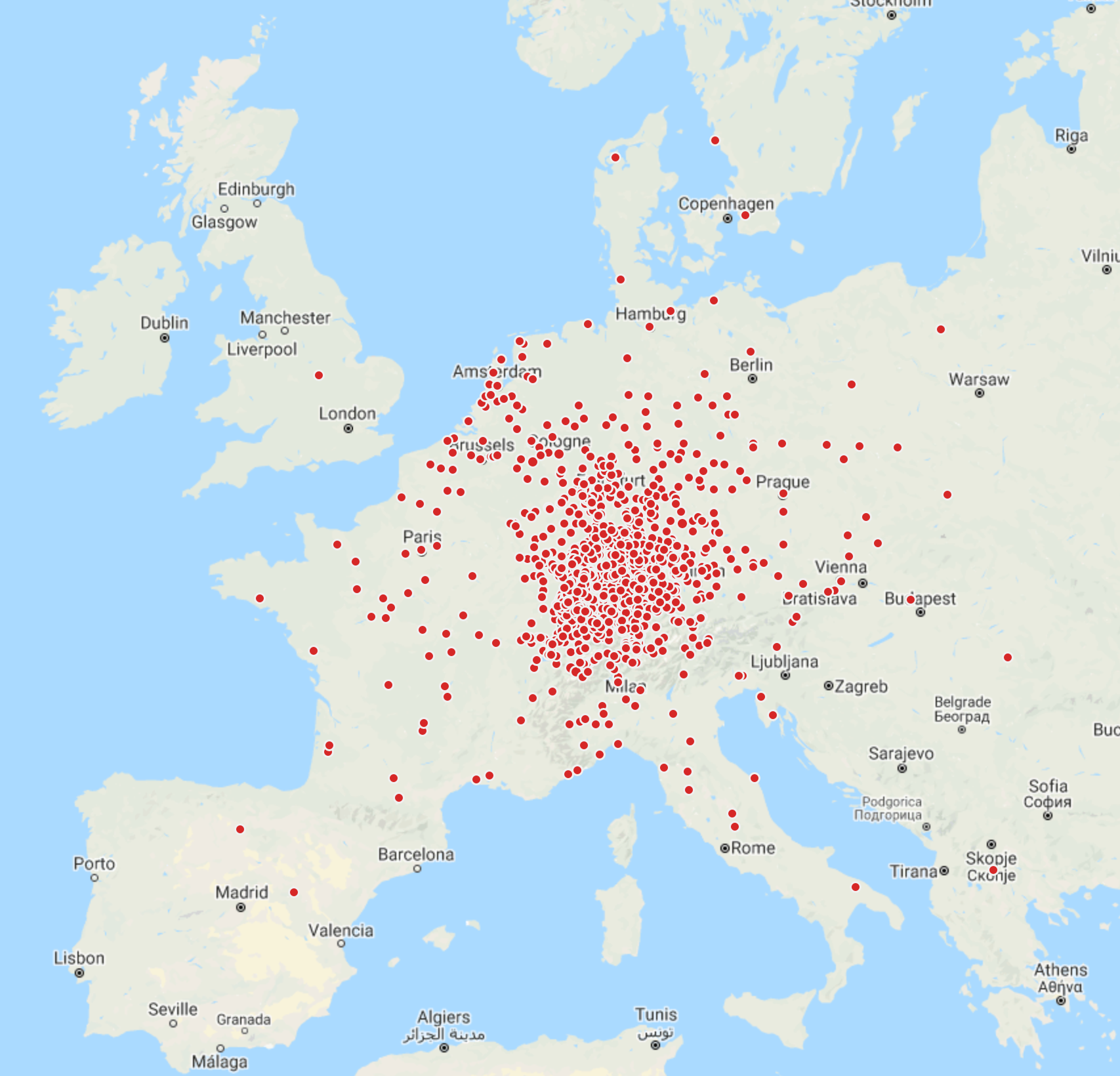
Places of origin of the 6000 students at the University of Basel 1460-1550 (Source: RAH). The University of Basel was by far the most frequented university by students from the Old Confederation.